
Why the UK’s Packaging EPR is missing the mark—and why Italy’s Decree-Law 143 shows us how it should be done. 🇬🇧🇮🇹
While the UK continues to roll out its Extended Producer Responsibility (pEPR) framework, businesses across the CPG and packaging sectors are raising the same concern: The UK policy acts as a tax collection engine rather than a circular economy strategy.
Under current UK pEPR guidelines, packaging design is treated through a narrow lens. Highly effective, food-safe alternatives—like certified EN 13432 compostable packaging—are routinely penalised with higher eco-modulated fees because DEFRA treats them as "non-recyclable" contaminants in dry mechanical streams. Instead of building the infrastructure to handle modern material innovation, the UK policy simply taxes what doesn't fit into legacy bin collections.
Enter Italy’s Decree-Law 143/2026 🇮🇹
While the EU Packaging and Packaging Waste Regulation (PPWR) sets blanket bans on single-use formats, Italy took a radically different, infrastructure-integrated approach:
1️⃣ Substitution over Blanket Penalties: Rather than banning items like small condiment sachets, fresh produce packaging (<1.5kg), or hotel toiletries, Italy mandates certified compostables for these specific formats.
2️⃣ EPR Built for Infrastructure: Through Biorepack—the world’s first dedicated EPR scheme for organic recycling—producer fees directly fund and expand industrial composting plants, ensuring organic packaging actually gets processed with food waste.
3️⃣ Outcome-Oriented Strategy: Instead of penalising innovation, Italy integrated compostables into its municipal biowaste stream, where it already achieves a ~58% organic recycling rate—surpassing EU 2030 targets years ahead of schedule.
The Takeaway
The UK approach: Penalty-driven. Tax hard-to-recycle formats without investing in the systems required to capture organic or flexible alternatives.
The Italian approach: Systemic. Align packaging legislation with real-world infrastructure so that necessary single-use items return safely to the soil.
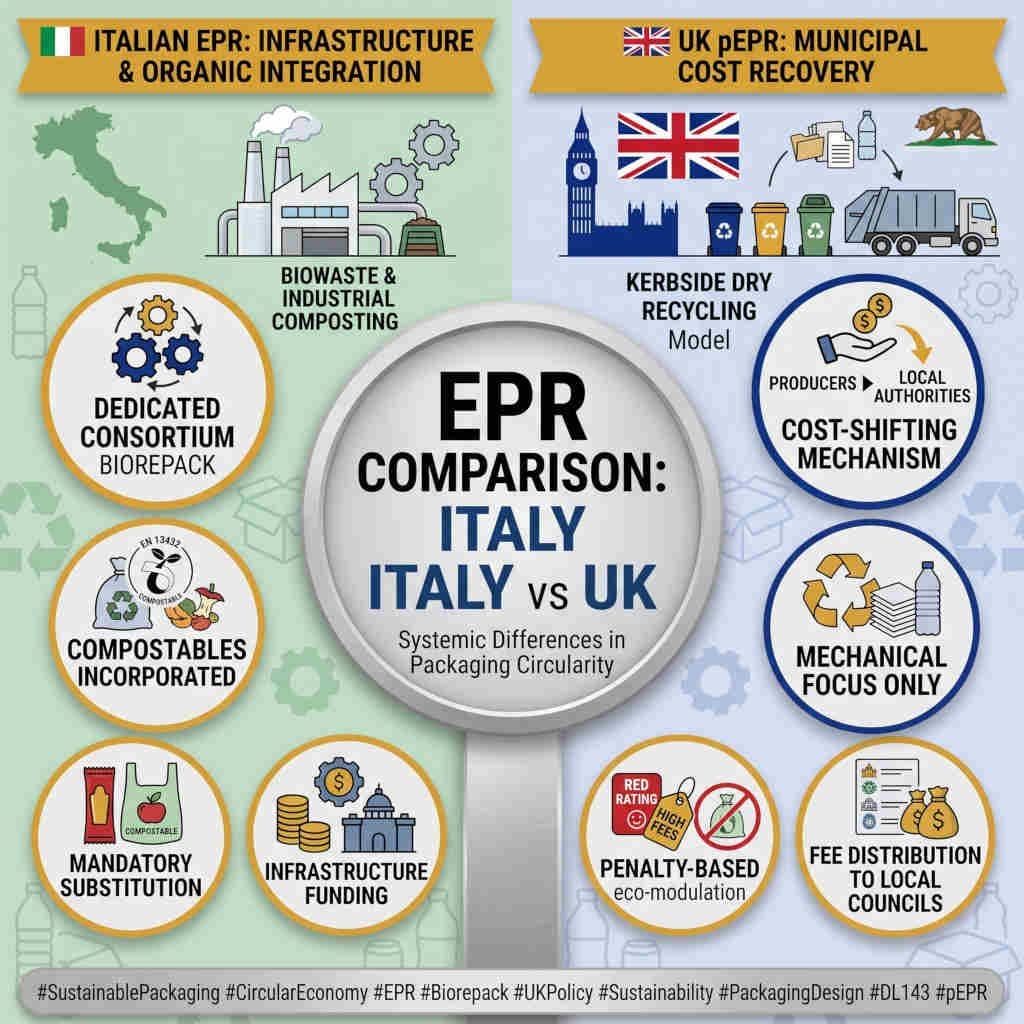
Comparison: Italy vs. UK Packaging EPR
| Comparison Feature | 🇮🇹 Italian System (CONAI / Biorepack / DL 143) | 🇬🇧 UK System (pEPR / PackUK Framework) |
|---|---|---|
| Core Regulatory Focus | Infrastructure & Organic Integration: Focuses on diverting organic waste by pairing legislation directly with local processing capability. | Municipal Cost Recovery: Focuses on shifting 100% of municipal packaging collection/disposal costs onto producers. |
| Treatment of Compostable Packaging | Incentivised & Dedicated Stream: Covered by Biorepack (a dedicated EPR consortium). Certified EN 13432 compostables are treated as a primary recovery route alongside food waste. | Penalized / Red-Rated: Under the UK’s Recyclability Assessment Methodology (RAM), compostable packaging is typically assigned a "Red" RAG rating (high fee surcharge) due to a lack of dedicated kerbside processing. |
| EPR Fee Modulation Structure | Targeted Material Grids: CONAI and Biorepack apply granular fee bands based on exact material type and processing feasibility (e.g., dedicated rates for paper, plastics, and compostables). | RAG Bonus/Malus Multipliers: Uses Red, Amber, and Green ratings applied as broad multipliers to base fees based on mechanical dry-recycling potential. |
| Single-Use Packaging Strategy | Mandatory Material Substitution: Where single-use items (e.g., small food packaging, sachets) are difficult to eliminate, Italy mandates or encourages conversion to certified compostables. | Broad Single-Use Ban & Fee Penalties: Bans specific single-use plastics and applies financial penalties via EPR fees, without establishing dedicated compostable substitution pathways. |
| EPR Scheme Administration | Material-Specific Consortia: Managed by private, industry-led consortia under CONAI (e.g., Biorepack for bioplastics, Corepla for traditional plastics). | Centralized Scheme Administrator: Managed centrally via PackUK/DEFRA, with compliance schemes acting as administrative representatives for producers. |
| Funding Allocation | Direct Infrastructure Reinvestment: Fees directly fund municipal organic waste collection networks and industrial composting/anaerobic digestion plants. | Local Authority Cost Offsets: EPR fees collected from producers are paid to local councils to offset standard household waste management and disposal costs. |
Core Structural Takeaway
Italy’s System: Functions as an integrated infrastructure model. By establishing Biorepack, Italy created a closed-loop system where producer fees directly build and maintain the industrial composting capacity required to process certified organic packaging alongside food waste.
The UK’s System: Functions primarily as a cost-shifting mechanism. Because the UK’s framework evaluates packaging almost exclusively on standard mechanical dry-recycling (paper, glass, traditional plastics), it penalizes compostables with higher fees rather than investing in the organic recycling infrastructure to process them.
If the UK wants a packaging framework that actually drives decarbonisation and circularity, it needs to stop treating pEPR as a cost-recovery mechanism and start designing an integrated infrastructure policy.
Is it time for DEFRA to re-evaluate how we handle compostables and advanced material streams in the UK?
#SustainablePackaging #CircularEconomy #EPR #PackagingPolicy #pEPR #Biorepack #UKPolicy #Sustainability #PackagingDesign


